


The Bechtle Group’s balance sheet total stood at €5,001.4 million as of 30 September 2026, up from €4,574.7 million as of 31 December 2025.
Non-current assets increased by 7.6% to €2,028.4 million. A notable contribution came from goodwill, which rose by €56.4 million as a result of acquisitions, while non-current contract assets increased by €46.4 million to €125.8 million, driven in part by multi-year software licence agreements. By contrast, non-current trade receivables decreased by −€19.0 million. Overall, the non-current asset ratio declined to 40.6% (31 December 2025: 41.2%).
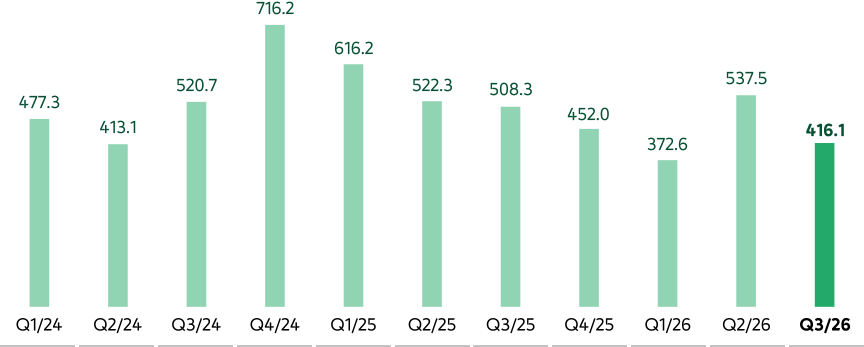
Current assets increased by €283.4 million to €2,973.0 million as of the reporting date. Inventories rose sharply by €285.5 million, or 74.8%, to €667.2 million as of 30 September 2026, reflecting both higher project volumes and call-off agreements, under which we allocate warehousing capacity to individual customers. These arrangements also allow us to respond strategically to price increases for memory chips. Trade receivables moved in the opposite direction, at −€53.0 million, or −3.9%. This positive development was also reflected in average days sales outstanding (DSO), which continued its downward trend and now stands at 36.2 days (previous year: 38.2 days). Cash and cash equivalents, including time deposits and securities, declined to €416.1 million at the end of the quarter, due to payments for acquisitions and the funding of organic growth.
Working capital rose sharply to €695.2 million as of 30 September 2026 (31 December 2025: €500.5 million), as the increase in inventories described above more than offset the reduction in trade receivables. Based on annualised business volume, however, the working capital ratio decreased only slightly from 7.4% to 7.2%.
Non-current liabilities rose substantially to €1,271.1 million as of the reporting date, primarily due to the placement of a €450 million Schuldschein loan, while non-current trade payables increased by €48.1 million.
By contrast, current liabilities fell by −€138.1 million to €1,592.5 million as of 30 September 2026, partly reflecting the repayment of a loan. Current trade payables also declined by −€41.9 million.
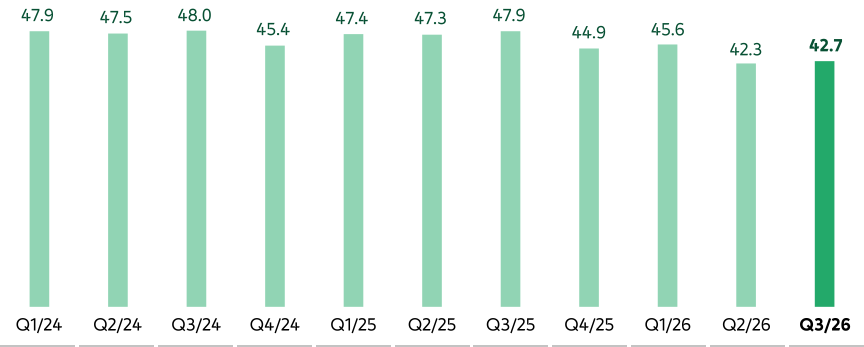
Equity increased by €85.5 million to €2,137.8 million. However, as the balance sheet total grew at a faster rate, the equity ratio declined from 44.9% as of 31 December 2025 to 42.7%. The annualised return on equity rose to 11.1%, from 10.3% in the prior-year period.
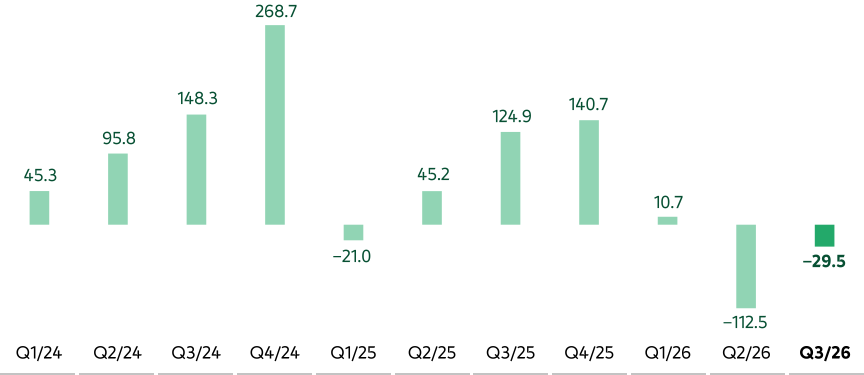
Operating cash flow stood at −€131.2 million from January to September 2026, compared with €149.1 million in the prior-year period.
This development was primarily driven by the following factors:
Following a more modest increase in the previous year, inventories rose substantially due to stronger growth and anticipated price increases for memory chips, resulting in a cash outflow of −€290.8 million (previous year: −€32.0 million).
Cash outflow related to other net assets increased significantly from −€43.0 million to −€218.6 million. This was due to the increase in contract assets, representing goods and services delivered but not yet invoiced, which likewise reflect the strong growth.
By contrast, the significant reduction in trade receivables generated a cash inflow of €82.0 million, slightly below the likewise positive prior-year figure of €109.6 million.
The cash outflow from the reduction in trade payables was −€1.3 million, substantially lower than the prior-year figure of −€115.0 million.
Cash flow from investing activities amounted to −€186.6 million (previous year: −€149.7 million). Payments for acquisitions came to −€55.3 million (previous year: −€83.1 million). Cash payments for investments in intangible assets and property, plant and equipment changed only slightly, from −€91.1 million in the previous year to −€93.8 million in the reporting period. The net cash flow from purchases and sales of time deposits and securities amounted to −€55.1 million, compared with €4.4 million in the previous year.
Cash flow from financing activities amounted to €225.9 million, compared with −€200.2 million in the prior-year period, reflecting substantially higher proceeds from the placement of a Schuldschein loan.
Free cash flow from January to September 2026 was −€271.7 million, significantly below the previous year’s −€16.7 million. In addition to payments for acquisitions, this is attributable in particular to capital expenditure and the considerably lower operating cash flow.