


Economic environment remains challenging
Business sentiment shows signs of modest recovery
Macroeconomy
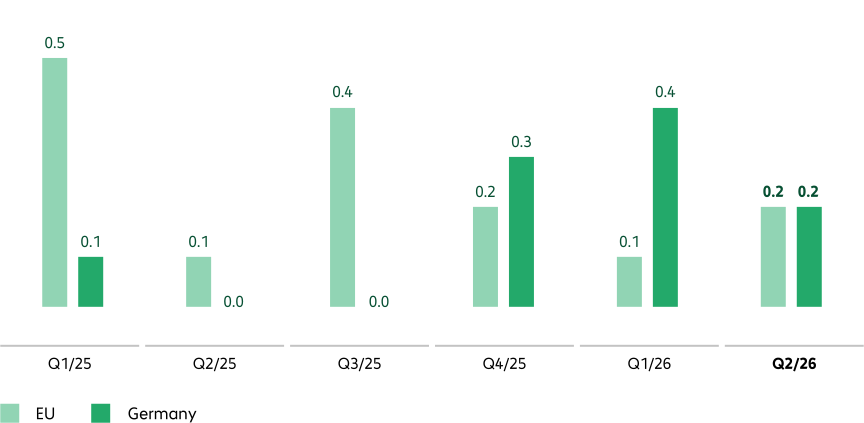
Economic activity in the European Union remained subdued in the first half of 2026. According to the European Commission, gross domestic product (GDP) grew by 0.1% in the first quarter and by 0.2% in the second. Performance varied considerably across the EU countries in which Bechtle operates, ranging in the first quarter from a decline of −2.0% in Ireland to growth of 0.8% in Hungary. In the second quarter, Spain and the Czech Republic recorded the highest growth rates, both at 0.5%, while Italy’s economic output contracted by −0.1%.
In Germany, GDP grew by 0.4% in the first quarter and by 0.2% in the second.
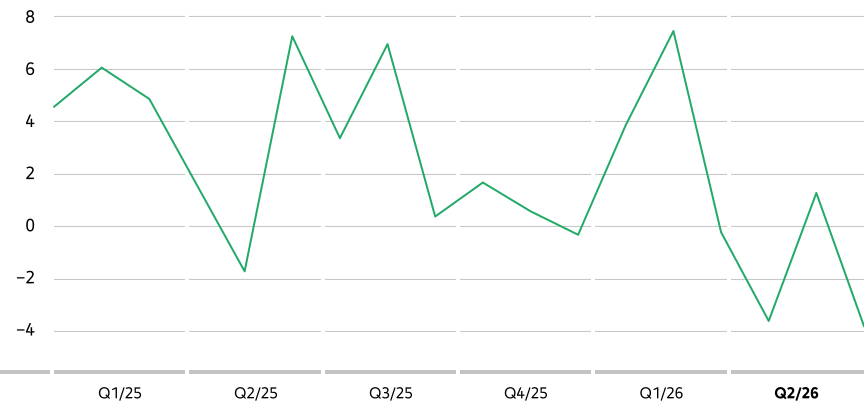
Germany’s subdued macroeconomic performance was also reflected in the ifo Business Climate Index. After improving slightly in February, the index fell at the start of the Iran war before sentiment recovered somewhat in May and June. Assessments of the current business situation remained broadly stable, reaching their highest level in two years in June, while expectations for the coming months declined more sharply and only began to recover slightly towards the end of the quarter.
Industry
The ifo Business Climate Index for IT service providers declined overall in the first half of the year, with considerable volatility over the period. While assessments of the current business situation remained slightly positive despite a marked decline towards the end of the quarter, business expectations weakened noticeably.
According to IDC, PC sales declined by almost 5% year on year. Gartner attributes this primarily to rising memory prices, weaker demand and generally more cautious purchasing behaviour among customers. At the same time, the market is seeing a shift towards higher-priced, AI-enabled PCs.
Overall assessment
The first half of 2026 unfolded against a mixed market backdrop, with the economy as a whole providing little impetus for growth. Uncertainty arising from geopolitical tensions and ongoing macroeconomic challenges remains elevated. In addition, energy prices increased as a result of the conflict with Iran, creating further headwinds. One encouraging development is that public-sector customers in Germany have benefited from greater planning certainty since the federal budget was approved in December 2025.
Although the IT market continues to outperform the broader economy, sentiment has also become somewhat more subdued. Strong demand for memory chips and the resulting sharp increase in prices for servers, storage systems and PCs have added to uncertainty across the market. While organisations continue to invest their IT budgets, rising prices are reducing hardware purchasing volumes.
Bechtle AG was able to navigate this challenging environment very successfully in the first half of the year. Our close relationships with customers and all key technology partners enabled us to address the challenges effectively and in the best interests of all parties involved.
Bechtle AG does not publish forecasts for individual quarters and therefore does not provide a comparison of actual performance against quarterly forecast figures. That said, business volume, revenue and earnings in the first half of 2026 exceeded the assumptions underlying our original forecast for full-year 2026. As a result, the Executive Board has decided to raise its forecast for full-year 2026.