


Our employees contribute significantly to the success of our company with their commitment and expertise. Bechtle benefits from great diversity among its employees, who all contribute different perspectives and experiences. To attract and retain qualified specialists, Bechtle favours a respectful, appreciative working environment with plenty of room for individual ideas and talents. We support this with a number of initiatives, including individual training and further education opportunities.
Development of employee numbers
The term “employees” refers to all persons working in the company who have a contractual relationship with a Bechtle company. While this includes our trainees and students on integrated degree programmes, it does not include temporary staff such as short-term or marginal employees, holiday jobbers, thesis writers, interns or working students.

Increase in the number of employees due to acquisitions
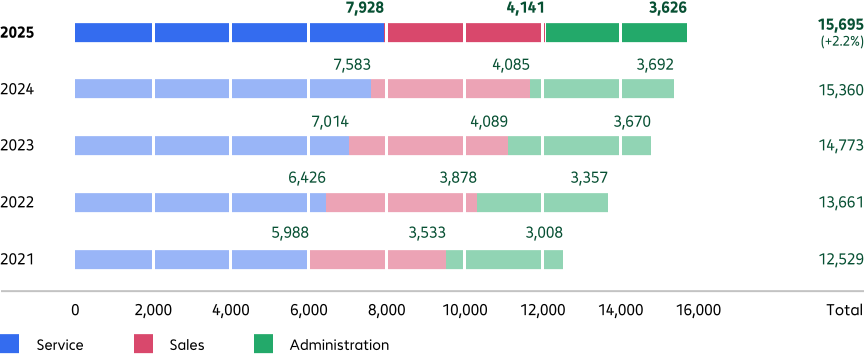
As of 31 December 2025, the Bechtle Group employed 16,360 people across the whole group of companies. Compared to the previous year (15,801 employees), the workforce increased by 559 people or 3.5 per cent. On a full-time equivalent (FTE) basis, Bechtle employed 15,452 people on average during the year (previous year: 14,926). This corresponds to an increase of 526 people, or 3.5 per cent.
The acquisitions made in Italy, the Netherlands and Spain in the fiscal year brought a total of 877 new colleagues to Bechtle. Although these acquisitions had a significant impact on Group-wide growth in the number of employees, organic growth declined by 2.0 per cent. This development is due, in particular, to the continuing challenging economic framework conditions in important sales markets for Bechtle in 2025.

At the beginning of 2025, we realigned our management organisation. As a result, we have also redefined the segments and are reporting this for the first time in this Annual Report. Accordingly, we report the number of employees according to the new segments.
A total of 10,419 people were working in Germany as of 31 December 2025. That is 63.7 per cent of our employees group-wide (previous year: 67.5 per cent). Compared to the previous year, the number of employees in Germany decreased by 239, corresponding to 2.2 per cent. The background to this is the conscious decision, in view of the challenging economic conditions, to carefully examine whether vacant positions need to be filled promptly.

The number of employees in France also fell slightly by 25 people or 2.0 per cent.

In contrast, the number of employees in the Benelux and Other Europe segments increased significantly compared to the previous year, due primarily to the aforementioned company acquisitions in Italy, the Netherlands and Spain.


When analysing the development of the number of employees in the individual functional areas, a significant increase can be seen in the service area. The number of employees rose by 345 in this area, representing an increase of 4.5 per cent. This is due to the international acquisitions, which primarily offer services. In sales, 56 new people joined Bechtle. At the end of the year, there were 66 fewer people working in administration than in the previous year.
Personnel expenses and salary model
Increase in personnel expenses disproportionately high
In the reporting period, expenses for wages and salaries, including social security contributions, increased by 5.8 per cent, which was disproportionately high relative to revenue growth. The personnel expense ratio increased from 18.6 per cent to 19.4 per cent. The personnel intensity, measured in terms of gross profit, rose year-on-year to 62.5 per cent (previous year: 61.9 per cent).
Our remuneration policy is based on market-oriented pay. We create individual performance incentives in the form of variable salary components, aligning them with business interdependencies. Whether or not a variable salary component is granted usually depends on the function and on the salary amount.
Training and Education
To meet the increasing demand for specialists and managers, we are focusing on developing talent from within our ranks. This is why we attach great importance to training and further education, development of employees and managers, and knowledge management. Personnel Development centrally designs and coordinates training and development programmes tailored to specific roles and disciplines for our domestic and foreign subsidiaries. The Bechtle Academy supplements these programmes with a comprehensive range of training courses for employees across all levels.
Training to future-proof the workforce
We view training as an investment in the future for the purpose of actively forestalling a shortage of qualified staff. We have been training people for 40 years now, and have established ourselves as a sought-after training company for numerous commercial and technical professions. Since 2000, we have also offered integrated degree programmes in various business management and technical subjects. In the reporting period, we added the profession of event management assistant to our training programme. Our training programme comprises a total of 24 job profiles and study subjects.
|
|
2025 |
|
2024 |
|
2023 |
|
2022 |
|
2021 |
|---|---|---|---|---|---|---|---|---|---|---|
Commercial trainees |
|
267 |
|
290 |
|
307 |
|
288 |
|
226 |
Technical trainees |
|
420 |
|
466 |
|
426 |
|
401 |
|
371 |
Commercial students on integrated degree programmes |
|
66 |
|
75 |
|
69 |
|
67 |
|
53 |
Technical students on integrated degree programmes |
|
54 |
|
52 |
|
40 |
|
37 |
|
41 |
Total |
|
807 |
|
883 |
|
842 |
|
793 |
|
691 |
In 2025, 251 young people started a traineeship or an integrated study programme at Bechtle. A total of 807 young people were in training at the end of the reporting period, 8.6 per cent fewer than in the previous year. A total of 645 young people were in training at our domestic companies, 8.6 per cent fewer than in the previous year. This decline is due to the challenging economic situation in the reporting period. Accordingly, the proportion of trainees in Germany fell to 6.2 per cent. At our headquarters in Neckarsulm, we were able to increase the proportion to 9.6 per cent (previous year: 8.2 per cent).

Training and further education is essential for Bechtle to secure its long-term success.
|
|
|
2025 |
|
2024 |
|
2023 |
|
2022 |
|
2021 |
|---|---|---|---|---|---|---|---|---|---|---|---|
Proportion of trainees |
% |
|
6.2 |
|
6.7 |
|
6.8 |
|
6.6 |
|
6.5 |
Upon successful completion of the training, we are able to offer almost all trainees and students on integrated degree programmes permanent employment contracts.
Bechtle offers a twelve-month trainee programme for university graduates. It is designed to prepare participants for specialist roles. The programme starts every quarter and enables participants to get to know different Bechtle services and divisions, build up an internal network and develop their professional and personal skills.
Comprehensive staff development programme
Bechtle’s Learning Campus provides a central learning platform offering a wide range of seminars, webinars, workshops and e-learning formats. It delivers a training programme for both newcomers and professionals, specific to each target group. All Bechtle employees have access to this system. The aim is to maintain a standardised level of knowledge at all locations and thus sustainably increase our competitiveness. Founded in 1999, the Bechtle Academy supports individual training at the group’s locations.
As part of our group-wide leadership initiative launched in 2020, we have set up various development programmes to recruit managers from within our own ranks. The Bechtle Junior Management Programme (JuMP) has two tracks: JuMP Leader is aimed at employees with no or junior management experience and prepares them to take on a more senior management role. JuMP Expert is a development programme for proven experts who do not wish to take on people management responsibilities. The Bechtle General Management Programme (GMP) focuses on corporate leadership. It qualifies managers to take on management duties. In addition, the Bechtle IT Business Architect (IT BA) programme and the newly launched IT Solution Architect (IT SA) programme offer employees with outstanding specialist knowledge an attractive opportunity for further development.
|
|
2025 |
|
2024 |
|
2023 |
|
2022 |
|
2021 |
|---|---|---|---|---|---|---|---|---|---|---|
Bechtle Junior Management Programme (JuMP) Leader |
|
96 |
|
112 |
|
106 |
|
120 |
|
85 |
Bechtle Junior Management Programme (JuMP) Expert |
|
43 |
|
63 |
|
59 |
|
21 |
|
– |
Bechtle General Management Programme (GMP) |
|
10 |
|
13 |
|
13 |
|
11 |
|
11 |
Bechtle IT Business Architect Programme (IT BA) |
|
13 |
|
12 |
|
16 |
|
17 |
|
12 |
Bechtle IT Solution Architect Programme (IT SA) |
|
26 |
|
– |
|
– |
|
– |
|
– |
The Bechtle management guidelines provide a binding framework for our managers to foster a successful, healthy and motivating work environment grounded in fairness, respect and professionalism. Various instruments and tools such as management feedback and a leadership toolbox help our managers to develop their leadership skills in a targeted and continuous manner, thereby increasing employee satisfaction.
Professional development extending to international locations
The ongoing internationalisation of our company means that the proportion of non-German-speaking colleagues at Bechtle continues to grow. The “International People Development” team acts as the central point of contact for all Bechtle Group companies outside Germany. Close cooperation with the central Staff Development department and the local staff development units means that we can offer a wide range of professional development opportunities to our international employees too.
Employer attractiveness
Employer branding strengthens employee retention
Attracting and retaining qualified talent is a key strategic and business priority. The growing skills shortage and demographic change are making the successful search for new employees increasingly challenging. There is also the risk of losing existing employees to competitors. We are countering these trends through targeted employer branding initiatives. At the beginning of 2026, we were once again certified as a Top Employer.
The employee turnover rate, calculated on the basis of a twelve-month moving average, totalled 7.6 per cent in the reporting period, positioning it well below the previous year’s figure of 9.1 per cent. The average length of service rose slightly to 6.5 years.
|
|
|
2025 |
|
2024 |
|
2023 |
|
2022 |
|
2021 |
|---|---|---|---|---|---|---|---|---|---|---|---|
Turnover rate |
% |
|
7.6 |
|
9.1 |
|
9.1 |
|
10.9 |
|
9.1 |
|
|
2025 |
|
2024 |
|
2023 |
|
2022 |
|
2021 |
|---|---|---|---|---|---|---|---|---|---|---|
Average length of service in years |
|
6.5 |
|
6.2 |
|
5.9 |
|
5.8 |
|
5.8 |
Diversity and equal opportunity
Diversity as a key to long-term viability
As an international IT company, Bechtle has a highly diverse workforce. At the end of 2025, we had employees of 112 different nationalities across the Group (previous year: 109). Diversity is key – to successful teams, strong customer and market engagement, and long-term business viability. Bechtle is firmly committed to equal opportunity and opposed to discrimination – irrespective of gender and gender identity, ethnic origin and nationality, physical and mental ability, religion and belief, sexual orientation, social background, age or other personal characteristics. This principle is enshrined in the Bechtle Code of Conduct. We publicly affirm this commitment as signatories to the Diversity Charter and the UN Global Compact.
Our DE&I strategy (Diversity, Equity & Inclusion) published in January 2025 is based on the seven dimensions of the Diversity Charter. Our initial focus is on four key dimensions: gender, physical and mental abilities, age and social background. Our goal is not simply to treat diversity as a value, but to systematically embed it in processes, structures and day-to-day practices. Initial, short-term measures in the defined focus dimensions have already been implemented.

The advancement of women is one of our priorities. Through various initiatives and measures, Bechtle aims to get women interested in the IT sector and increase the proportion of women in the company. One example here is our support for the Baden-Württemberg state initiative “Women in STEM professions”. For female career starters or women with professional experience who are interested in a career in the IT sector, Bechtle offers a wide range of introductory and entry programmes and specifically supports young female professionals entering the world of IT.
With “female upgreat”, Bechtle Stiftung gGmbH launched the first scholarship programme for the long-term promotion and support of girls and women in the IT business environment. The programme is aimed not only at schoolgirls, trainees and students, but also at career starters, managers and experts. The aim is to encourage more girls and women to pursue a career in IT and to accompany them on their way to specialist and management positions for up to 15 years through numerous further training programmes. The programme is implemented in close cooperation with the Gerhard and Ilse Schick Foundation, and the first 49 scholarship holders started in January 2025. Two further application phases followed during the year. In total, 103 girls and women were actively supported in the reporting period.

Through its read-aloud initiative “Susu macht das”, the Bechtle Foundation promotes education and equal opportunities on Germany’s National Reading Day.
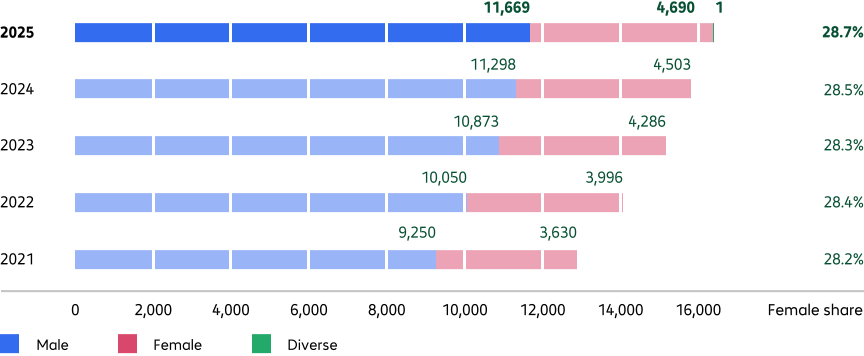
As of 31 December 2025, the Bechtle Group employed 4,690 women (previous year: 4,503); this corresponds to 28.7 per cent of the total workforce (previous year: 28.5 per cent). The proportion of women among trainees and students on integrated degree programmes was 26.1 per cent.
|
|
|
|
2025 |
|
2024 |
|
2023 |
|
2022 |
|
2021 |
|---|---|---|---|---|---|---|---|---|---|---|---|---|
Trainees |
|
% |
|
26.1 |
|
26.2 |
|
25.8 |
|
26.7 |
|
23.2 |
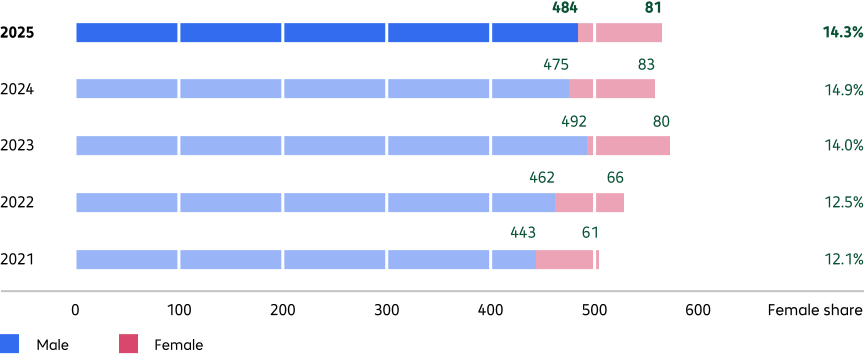
As of 31 December 2025, the proportion of female managers in the entire Group was 14.3 per cent (previous year: 14.9 per cent).
Focus on the proportion of women in management positions
As in the previous year, the proportion of women on the Supervisory Board was 37.5 per cent in the reporting period. The Group Executive Board should include a woman by 30 June 2025. This target has been met since 1 February 2024 with the appointment of Antje Leminsky.
The new targets set by the Executive Board for the proportion of women below the Executive Board have applied since 27 January 2025. For the first management level below the Executive Board, the Executive Vice Presidents or Vice Presidents, a target of 25 per cent, or four positions, will apply with effect from 1 February 2025. With two women currently at this management level, this goal has not been achieved yet.
The Executive Board has set a target of 20 per cent, or 26 positions, for the second management level below the Executive Board, which comprises those in management positions at the subsidiaries and those reporting directly to an Executive Board member (“direct reports”) in the inner management circle. As of 31 December 2025, the proportion of women at this management level was 13.0 per cent, or 16 positions. In the previous year, the proportion of women was 11.7 per cent. Bechtle was thus able to increase the proportion compared to 2024; however, the target figure has not yet been reached here either.
The deadline for achieving the defined targets is 31 January 2030.
For more information, see Corporate Governance Statement
For more information, see Sustainability Statement, Social information, Own Workforce
|
|
|
|
2025 |
|
2024 |
|
2023 |
|
2022 |
|
2021 |
|---|---|---|---|---|---|---|---|---|---|---|---|---|
Supervisory Board |
|
30% by law |
|
37.5% |
|
37.5% |
|
37.5% |
|
33.3% |
|
33.3% |
Executive Board |
|
At least one person |
|
25% |
|
25% |
|
0% |
|
0% |
|
0% |
First management level below the Executive Board |
|
25% or 4 positions |
|
11.8% or 2 positions |
|
13.3% |
|
0% |
|
0% |
|
0% |
Second management level below the Executive Board |
|
20% or 26 positions |
|
13% or 16 positions |
|
11.7% |
|
11.2% |
|
10.7% |
|
7.8% |