


In 2025, too, the economic and political framework conditions remained very tense. In addition to the ongoing war in Ukraine and the conflicts in the Middle East, the tariffs imposed by the United States in particular led to increased uncertainty. In Germany meanwhile, once a government was formed and budgets were adopted for 2025 and 2026, the country gradually returned to more predictability, which was particularly noticeable for Bechtle with public-sector clients. This underpins the trend reversal in the development of GDP in Germany, with the other economies in the EU also showing growth. The IT market once again outperformed the macroeconomy, and although Bechtle was initially unable to fully escape the economic burdens, it significantly increased its year-on-year growth rates towards the end of the year.
Macroeconomy
The macroeconomy is growing
As in the previous year, 2025 was characterised by economic and geopolitical uncertainties. The reasons for this included the ongoing war in Ukraine, the conflicts in the Middle East and an overall politically tense situation, due partly to the actions of the US administration. According to figures from the European Commission as of November, the EU’s gross domestic product (GDP) nevertheless rose by 1.4 per cent in 2025, which was more than in the previous year (1.1 per cent), with slight growth achieved in all quarters. Performance varied once again in the different Bechtle markets within the EU, with by far the best development in the reporting period seen in Ireland, which recorded growth of 10.7 per cent. At the lower end of the scale, alongside Germany, are the economies in Austria and Italy with a slight increase in GDP of 0.3 per cent and 0.4 per cent, respectively.

After two consecutive years of recession, the German economy showed first signs of stabilisation in the reporting period. According to the Federal Statistical Office, GDP grew slightly by 0.2 per cent, following a decline of 0.5 per cent in the previous year. The development in the individual quarters reflects the overall subdued economic momentum, with GDP rising by 0.4 per cent in the first quarter compared to the previous quarter. At −0.2 per cent, the second quarter recorded the only decline in the reporting period. In the third quarter economic development stabilised compared to the previous quarter, but stagnated at 0.0 per cent. The slightly positive trend continued towards the end of the year and led to growth of 0.3 per cent in the fourth quarter. Investment in equipment remained under pressure for the year as a whole and fell by 2.3 per cent, while government investments, by contrast, rose by 1.5 per cent.
The ifo Business Climate Index for Germany showed no sustained upward trend over the course of the year. In January, the index stood at 85.4 points, then from February onwards the value recovered in small steps and reached its high for the year of 88.8 points in August. At the end of the year, the index closed at 87.6 points, above the level at the beginning of the year.
Industry
German IT market continues to grow
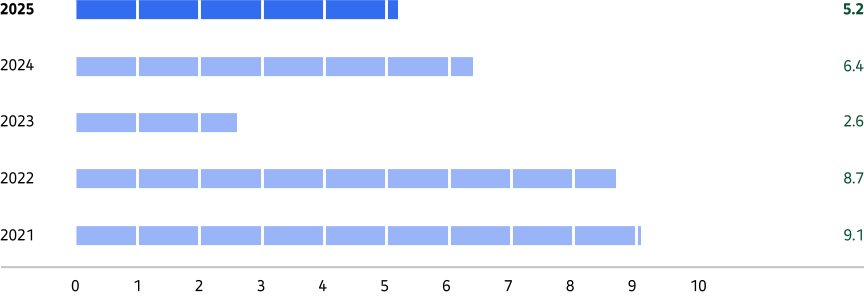
According to the industry association bitkom, the IT market in Germany continued to develop positively in 2025, growing by 5.2 per cent despite the ongoing challenge of the economic framework conditions. Although this growth did not match the previous year’s level of 6.4 per cent, it underlines the continued stability and resilience of the IT sector. At 3.8 per cent, growth in the IT hardware business was stronger than in the previous two years, but still disproportionately low compared to the market as a whole. Service sales increased by 2.7 per cent, with software sales remaining the primary growth driver, achieving a strong increase of 9.5 per cent, although they were unable to match the previous year’s level of 13.6 per cent.
According to the French industry association numeum, the IT market in France recorded moderate growth of 2.0 per cent in 2025. Its performance was therefore again significantly weaker than that of the German IT market.
The ifo index for IT service providers reflects the tense mood in the industry. In 2025, the net value of the index fell from 4.6 points to −0.3 points, reaching an annual low of −1.7 points in May.
Overall assessment and impact of the economic environment
Challenging framework conditions persist
The development of the macroeconomy was extremely challenging in the reporting period due to the numerous centres of conflict and crises described above. Nevertheless, both energy prices and the inflation situation have stabilised further and reached a normal level. The €500 billion special fund for infrastructure and climate neutrality, announced by the German Federal Government in the spring and adopted later in the year also provided a slight boost to business sentiment. Despite this, economic growth in our national markets remained at a rather low level, although the situation in the IT market was more positive – as evidenced in particular by the continuing high demand for software. The reluctance to buy IT hardware also eased somewhat.
Bechtle is growing faster than the IT market and is thus expanding its market share
Against this business environment, the Bechtle Group performed well. Overall, growth in business volume in the reporting period was above that of the IT market, and Bechtle’s market share thus increased further. Rising investments in the customer group comprising public-sector clients offset the continued reluctance to buy in the SME sector and in our national market of France.
Apart from the challenges indicated, the Bechtle markets did not witness any material events outside the company that had a noteworthy impact on business performance.