

In accordance with Article 8 of Regulation (EU) 2020/852 of the European Parliament and of the Council of 18 June 2020 on the establishment of a framework to facilitate sustainable investment and the delegated acts adopted to this end (hereinafter referred to as the “EU taxonomy”), entities that are obliged to provide non-financial reporting have had to disclose information on environmentally sustainable revenue, investments (CapEx) and operating expenses (OpEx) since the 2021 fiscal year. Delegated Regulation (EU) 2026/73 has already been applied for the 2025 reporting period.
The regulations distinguish between “taxonomy-eligible” and “taxonomy-aligned” activities. Activities are considered taxonomy-eligible if they can be assigned to the description of an economic activity. Economic activities can also make a material contribution to at least one of the following six environmental targets of the EU taxonomy:
Climate mitigation
Adaptation to climate change
Sustainable use and protection of water resources
Transformation to a circular economy
Avoidance of pollution
Protection of ecosystems and biodiversity
If the activity also causes no significant harm to any of the other environmental targets (do no significant harm – DNSH) and basic social, labour and human rights standards are complied with (minimum social safeguards – MSS), an activity is considered to be taxonomy-aligned.
Compliance with the technical measurement criteria was checked and reported on the basis of the following regulations:
Delegated Regulation (EU) 2021/2139
Delegated Regulation (EU) 2021/2178
Delegated Regulation (EU) 2023/2485
Delegated Regulation (EU) 2023/2486
Delegated Regulation (EU) 2026/73
Business activities that are covered by the EU taxonomy classification system are taxonomy-eligible. In addition to the revenue-relevant core business, this also includes individual actions and the acquisition of output from taxonomy-eligible activities (“cross-cutting activities”) that are only associated with investment and operating expenses (called CapEx and OpEx type C). Economic activities that are not currently covered by the EU taxonomy cannot be classified as taxonomy-eligible or aligned.
The scope of consolidation for taxonomy reporting at the group level corresponds to that of group financial reporting. This includes all subsidiaries of the group in accordance with Chapter 6 of EU Directive 2013/34/EU. The amounts used to calculate taxonomy-eligible revenue, CapEx and OpEx are based on the figures in the consolidated financial statements.
As in the 2024 fiscal year, no taxonomy-eligible revenue is reported due to immateriality. At 1.6 per cent, taxonomy-eligible revenue is below the materiality threshold that will apply when the new Delegated Regulation comes into force. Bechtle’s core activities comprise the trading business with IT products, which account for the majority of revenues and IT services. Eligible economic activities identified in the context of the EU taxonomy do not relate to Bechtle’s core business. Revenue corresponds to the revenue recognised in the consolidated income statement (“Revenue” item) in Bechtle’s consolidated financial statements.
CapEx includes in particular additions to property, plant and equipment and intangible assets before depreciation, amortisation and revaluations in accordance with the development of property, plant and equipment. The EU taxonomy divides CapEx metrics into three categories (c). Our CapEx metrics relate to the acquisition of output and individual actions in category c. This comprises the non-revenue-related acquisition of output from taxonomy-eligible economic activities and individual actions that enable the target activities to achieve greenhouse gas reductions or become low-carbon.
The calculation of total OpEx (operating expenses) as defined by the EU taxonomy includes direct, non-capitalised operating expenses in connection with assets or processes that may contribute to maintaining and improving the sustainable performance of a company. These include, in particular, expenses from maintenance and repairs, leasing expenses, expenses from building refurbishment actions and research and development expenses. For Bechtle, it comprises the maintenance costs for buildings, machinery and equipment. Bechtle is not R&D-intensive; the main costs in the area of building renovation and leasing are capitalised as CapEx. The insignificance of the total expenses for the business model due to its characterisation as a trading company means that reporting is dispensed with.
Firstly, the economic activities relevant to Bechtle were determined. The analysis of taxonomy-eligible activities was based on a checklist for revenue-relevant activities and cross-cutting activities, which contains all EU taxonomy activities. From this, a shortlist was drawn up that includes all activities relevant to the Bechtle business model and the corporate infrastructure within the scope of consolidation. These activities form the basis for the subsequent allocation of revenue, capital expenditures (CapEx) and operating expenses (OpEx). In order to avoid double counting, each relevant business transaction was allocated to a single economic activity and to one environmental objective. All six environmental objectives and the technical evaluation criteria were taken into account in the survey of taxonomy-eligible activities. The following taxonomy-eligible, material activities were identified:
Cross-cutting activities:
CCM 6.4 Operation of devices for personal mobility, bicycle transport logistics
CCM 6.5 Transport by motorbikes, passenger cars and light commercial vehicles
CCM 7.4 Installation, maintenance and repair of charging stations for electric vehicles
CCM 7.6 Installation, maintenance and repair of renewable energy technologies
CCM 7.7 Acquisition and ownership of buildings
Answer 147 from Commission notice C/2023/267 optionally allows new buildings for an entity’s own use to be allocated to activity CCM 7.7. Bechtle follows this approach and allocates new buildings to activity CCM 7.7. The alignment criteria in area CCM 7.7 correspond to Bechtle’s sustainable property concept, which is pursued for new buildings as well as rentals and property.
The activities CCM 6.5 and CCM 7.7 are material for Bechtle due to their financial size and were therefore checked for taxonomy alignment. The activities CCM 6.4, CCM 7.4 and CCM 7.6 were reviewed as they are material due to qualitative aspects and are included in Bechtle’s sustainability strategy. As a result of the materiality assessment, activities CCM 4.22, CCM 7.2, CCM 8.1, CCM 8.2, CE 5.2, CE 5.4, CE 5.5 and CE 5.5 were excluded from the further analysis of taxonomy eligibility and alignment due to a lack of financial materiality.
For activity CCM 6.4 (operation of personal mobility devices – job bikes), all leased bicycles fulfil the criteria for a material contribution to climate mitigation as they are emission-free or powered by muscle power and are used in the intended public infrastructure. The DNSH criteria are also fulfilled: There are no climate risks for this non-critical infrastructure and the bikes are maintained, reused or recycled according to the waste hierarchy. The company bicycles totalling €2,708 thousand can therefore be recognised as taxonomy-eligible and taxonomy-aligned.
For activity CCM 6.5 (transport with motorbikes, cars and light commercial vehicles), the DNSH criteria cannot currently be fully verified as disclosures on the external rolling noise of the tyres are missing. The vehicles are therefore recognised as not aligned with the taxonomy. However, around 57 per cent of the fleet in Germany fulfils the CO2 criterion of less than 50 gCO2/km and thus makes a significant contribution to climate mitigation. Bechtle has thus identified CapEx totalling €27,939 thousand in the CCM 6.5 activity as taxonomy-eligible. Bechtle is continuing to push the electrification of its vehicle fleet as part of the climate transition plan.
For activity CCM 7.4 (installation, maintenance and repair of charging stations for electric vehicles), the technical evaluation criteria in accordance with CCM 3.20 cannot currently be fully demonstrated as proof of taxonomy-alignment of the charging stations is only possible in cooperation with the suppliers and the required verification is not possible. The activity is therefore formally recognised as not aligned with the taxonomy. CapEx in the amount of €1,001 thousand is taxonomy-eligible.
For activity CCM 7.6 (installation, maintenance and repair of renewable energy technologies), the technical evaluation criteria in accordance with CCM 3.1 cannot currently be fully demonstrated as proof of taxonomy-alignment of the photovoltaic systems is only possible in cooperation with the suppliers. The activity is therefore formally recognised as not aligned with the taxonomy.
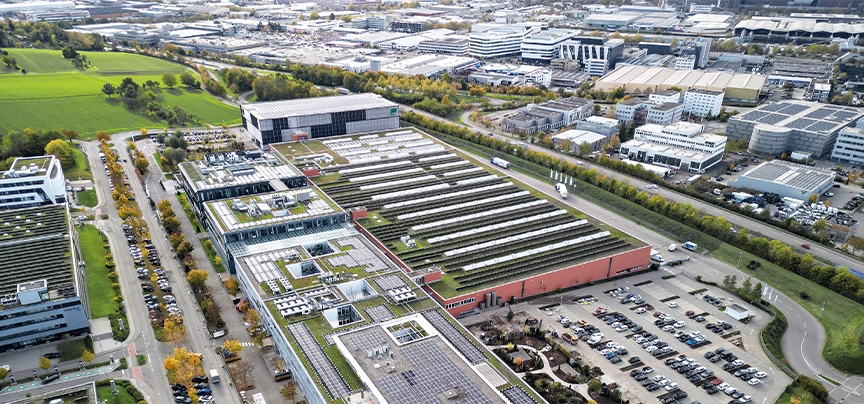
Activity CCM 7.7 includes capitalised rights of use, property and new buildings. New buildings fulfil the criteria for a material contribution to climate mitigation as their primary energy requirement is at least 10 per cent below the threshold value for nearly zero-energy buildings. All new buildings are equipped with building automation systems. The other criteria do not apply due to a usable area <5000 m2. The DNSH criterion for adaptation to climate change is fulfilled for all buildings as no material physical risks were identified as part of the climate risk analysis. In the 2024 fiscal year, Bechtle conducted a comprehensive climate risk analysis to systematically assess physical climate risks. The analysis was carried out in accordance with the regulatory requirements of the EU taxonomy and is based on recognised climate scenarios. The assessment shows that Bechtle has a high level of resilience and that no material physical risks have been identified. A description of the climate risk analysis can be found in the General information chapter. New buildings are therefore recognised as taxonomy-aligned for the 2025 fiscal year. The required building energy certificates could not currently be obtained for rented buildings, which is why they are not recognised as taxonomy-aligned. For the activity CCM 7.7 CapEx, a total of €69,433 thousand was determined to be taxonomy-eligible and €15,603 thousand to be taxonomy-aligned.
As a result, Bechtle identified 36 per cent of CapEx totalling €101,241 thousand as taxonomy-eligible and €18,311 thousand as taxonomy-aligned. Our taxonomy-aligned CapEx has increased because we are increasingly focussing on energy efficiency as part of our property concept in the course of new builds.