


The year 2025 was another challenging one. Our key national markets of Germany and France continued to be affected by the tense economic framework conditions and, in particular, the reluctance to invest among SMEs. Demand from public-sector clients in Germany was also subdued in the first nine months of 2025. By contrast, we achieved very pleasing growth rates across the board in Benelux and in other national markets, which we summarise in Other Europe. These regions also benefit from our targeted acquisitions in recent years. Due to the subdued business development in the first nine months, earnings were under greater pressure, and the very positive development in the fourth quarter could not fully compensate for this. Nevertheless, Bechtle is proposing a stable dividend for the 2025 fiscal year as a clear sign of reliability and confidence.
New segmentation
The business activities of the Bechtle Group were previously divided into two segments: IT System House & Managed Services and IT E-Commerce. At the beginning of 2025, the management organisation was realigned, and since then Bechtle has pooled responsibility for all distribution channels in the national markets at Executive Board level in one place. Starting with this Annual Report, external reporting will now also follow this logic. The reporting segments are based on our regional markets and are therefore:
Germany
France
Benelux
Other Europe (Austria, Czech Republic, Hungary, Ireland, Italy, Poland, Portugal, Spain, Switzerland, the United Kingdom)
For more information, see Business Activity, Business Model
For more information, see Business Activity, Business Segments
Order position
Significant increase in order backlog
Bechtle concludes both short-term and long-term contracts for the sale of IT products and the provision of services. In the pure trading business, order and delivery times are typically short, with project durations ranging from a few weeks to a year. In the fields of managed services and cloud computing in particular, Bechtle often concludes master and operating agreements that have terms of several years. Contract terms for as-a-service models, such as for the procurement of software, can also be longer than one year.
At €9,250 million, incoming orders in the reporting period were 12.7 per cent higher than the previous year’s figure of €8,209 million. The high growth is due to a remarkably strong spurt at the end of the year, particularly in the call-off of framework agreements with public-sector clients in Germany.
The order backlog increased significantly due to the positive trend in incoming orders. At the end of the year, it totalled €3,210 million and was therefore 25.6 per cent higher than the previous year’s figure (€2,556 million). Of this amount, €2,116 million was attributable to the Germany segment (previous year: €1,827 million), €98 million to France (previous year: €83 million), €519 million to Benelux (previous year: €330 million) and €477 million to the Other Europe segment (previous year: €316 million). The order backlog for the Group totalled around four and a half months.
Business volume
Business volume increased significantly
The business volume is an alternative performance indicator that Bechtle introduced in the 2021 Annual Report as part of the adjustment to the presentation of revenue in accordance with IFRS 15. This indicator describes the recorded revenue on a gross basis, i.e. without a reduction for software revenues as an agent in accordance with IFRS 15.
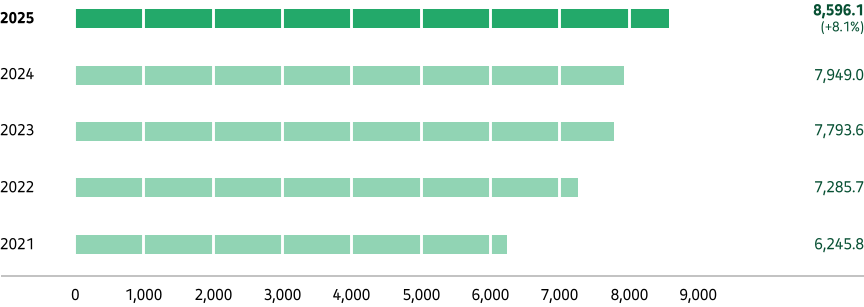
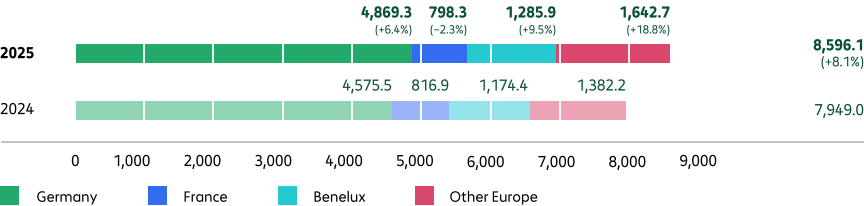
The business volume in the 2025 fiscal year totalled €8,596.1 million, up 8.1 per cent on the previous year (€7,949.0 million). In organic terms, the business volume also developed positively with growth of 5.2 per cent. After a slow start, the growth momentum of the business volume increased over the course of the year. The fourth quarter in particular benefited from strong demand and recorded an increase of 16.6 per cent.
Development varied within the segments. In France, the business volume fell by 2.3 per cent. This continues to reflect the challenging economic situation coupled with domestic political uncertainty. In addition, we have a higher proportion of medium-sized industrial customers in France, which means that business with public-sector clients cannot have quite the same stabilising effect as in other regions. In Germany, the business volume increased by 6.4 per cent. Meanwhile, the development in Benelux and Other Europe was very pleasing, with high growth rates of 9.5 per cent and 18.8 per cent, respectively. Our acquisitions in Spain and Italy play an important role in the latter. In all regions, the fourth quarter in particular contributed to this overall positive development with especially strong demand from public-sector clients.

Business volume increased significantly in 2025, benefiting in particular from strong demand in the fourth quarter.
Revenue performance
Revenue grows less than business volume
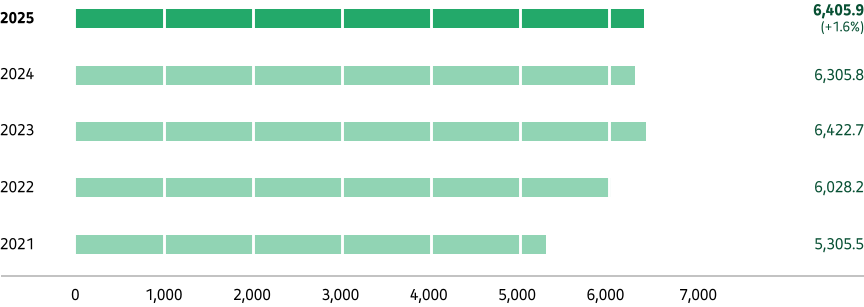
Our software business performed disproportionately well in the reporting period, although its volume cannot be recognised in full in accordance with IFRS 15. This meant revenue showed a weaker development than the volume of business, It rose from €6,305.8 million to €6,405.9 million, an increase of 1.6 per cent. Organic revenue performance totalled −1.9 per cent.
Varying regional distribution
The regions showed varying performance in the reporting period. While revenue in Germany and France declined by −1.4 per cent and −5.4 per cent, respectively, Benelux recorded a slight increase of 0.9 per cent. The Other Europe segment recorded a significant increase of 16.6 per cent, which is attributable primarily to the acquisitions made – in organic terms, the increase totalled 0.6 per cent.
In terms of total revenue, the international companies accounted for 41.7 per cent (previous year: 39.9 per cent). The share of the Germany segment thus totalled 58.3 per cent (previous year: 60.1 per cent). Germany remains Bechtle’s largest market.
The average number of full-time equivalents (FTEs; excluding absentees and trainees) rose only moderately by 3.0 per cent and was driven solely by acquisitions. Revenue per employee thus totalled €452 thousand (previous year: €458 thousand) with 14,181 full-time equivalents (previous year: 13,763).
Cost and earnings performance
Cost of sales
In 2025, gross earnings increased at a faster rate than revenue by 4.7 per cent to €1,191.5 million, compared to €1,138.4 million in the previous year. At 0.9 per cent, the cost of sales rose less than revenue due to the cost of materials, which only increased by 0.2 per cent. The background to this is the positive development in our software and service business, and this compensated for the disproportionately high increases in other expense items. Within the cost of sales, personnel expenses increased by 3.9 per cent, depreciation and amortisation by 15.6 per cent and other operating expenses by 12.1 per cent. Other operating expenses include higher expenses for our own IT and, in the case of depreciation, increased investments in property, plant and equipment. The gross margin thus increased from 18.1 per cent to 18.6 per cent.
|
|
|
2025 |
|
2024 |
|
2023 |
|
2022 |
|
2021 |
|---|---|---|---|---|---|---|---|---|---|---|---|
Cost of sales |
€m |
|
5,214.4 |
|
5,167.4 |
|
5,300.8 |
|
4,974.8 |
|
4,385.5 |
Gross earnings |
€m |
|
1,191.5 |
|
1,138.4 |
|
1,121.9 |
|
1,053.4 |
|
920.0 |
Gross margin |
% |
|
18.6 |
|
18.1 |
|
17.5 |
|
17.5 |
|
17.3 |
Distribution costs and administrative expenses
Expenses in the functional areas of sales and administration both rose significantly faster than revenue. Distribution costs increased by 6.0 per cent to €483.8 million in the reporting period, compared to €456.5 million in the previous year. The distribution cost ratio was 7.6 per cent, compared to 7.2 per cent in the previous year. Administrative expenses increased by 10.4 per cent from €382.9 million to €422.7 million, with higher personnel expenses due to an increase in average number of FTEs particularly noticeable here. In addition, an increase in depreciation and amortisation as well as other operating expenses reflect the increased investments in property, plant and equipment and higher expenses for our own IT. The administrative expense ratio thus increased from 6.1 per cent in the previous year to 6.6 per cent. Other operating income fell by 4.0 per cent in the reporting period from €52.4 million to €50.3 million. The decline was due mainly to additional manufacturer grants we received in the first quarter of 2024 and that were no longer paid out in the same amount in 2025. In the other quarters, the previous year’s level was maintained.
|
|
|
2025 |
|
2024 |
|
2023 |
|
2022 |
|
2021 |
|---|---|---|---|---|---|---|---|---|---|---|---|
Distribution costs |
€m |
|
483.8 |
|
456.5 |
|
436.7 |
|
393.0 |
|
345.2 |
Distribution cost ratio |
% |
|
7.6 |
|
7.2 |
|
6.8 |
|
6.5 |
|
6.5 |
Administrative expenses |
€m |
|
422.7 |
|
382.9 |
|
356.8 |
|
340.8 |
|
282.6 |
Administrative expense ratio |
% |
|
6.6 |
|
6.1 |
|
5.6 |
|
5.7 |
|
5.3 |
Earnings
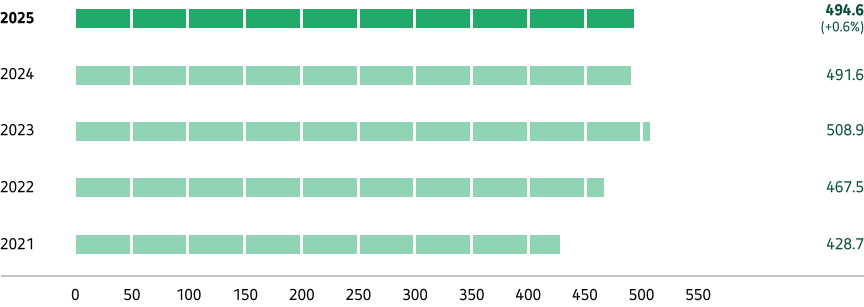
EBITDA is defined as earnings before financial income and expense, taxes, depreciation and amortisation. In the reporting period, EBITDA rose by 0.6 per cent from €491.6 million to €494.6 million. The EBITDA margin fell slightly from 7.8 per cent to 7.7 per cent.
Depreciation and amortisation increased by 13.5 per cent from €140.3 million in the previous year to €159.3 million in the reporting period. This is due partly to acquisitions, which led to a 22.5 per cent increase in amortisation of customer bases to €19.4 million (previous year: €15.8 million). However, the largest share of depreciation and amortisation was still attributable to property, plant and equipment and miscellaneous items at €133.2 million, compared to €117.1 million in the previous year.
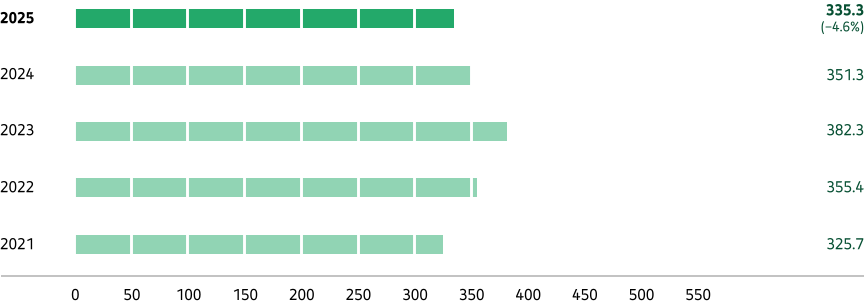
Earnings before interest and taxes (EBIT) totalled €335.3 million, down 4.6 per cent on the previous year’s figure of €351.3 million. The EBIT margin fell from 5.6 per cent to 5.2 per cent in the reporting period.
Financial income and financial expenses totalled −€11.1 million, compared to −€6.0 million in the previous year. This is due to both lower financial income and higher financial expenses in the reporting period.
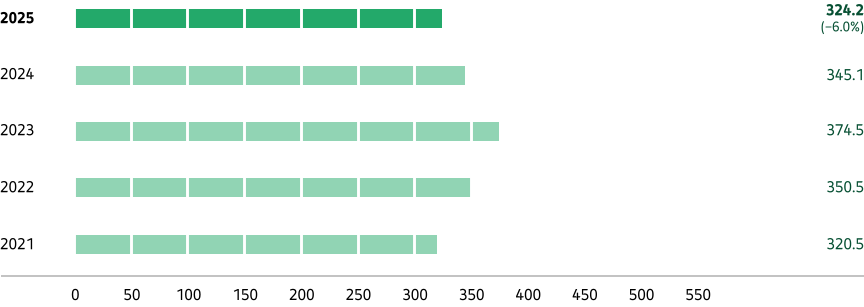
Earnings before taxes (EBT) fell by 6.0 per cent to €324.2 million, compared to €345.1 million in the previous year.
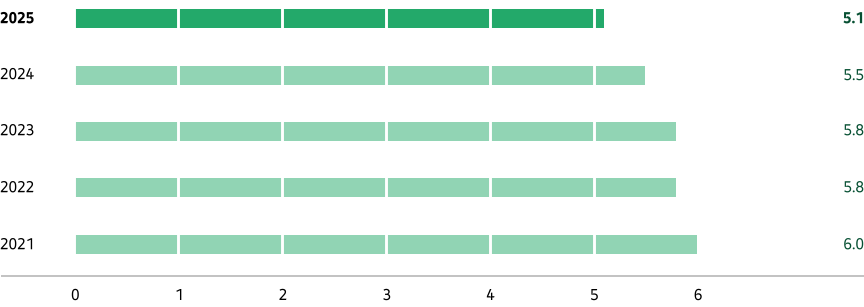
The EBT margin in 2025 was 5.1 per cent, compared to 5.5 per cent in the previous year.
In the reporting period, income tax expenses fell by 4.3 per cent to €95.9 million (previous year: €100.2 million). The tax rate increased from 29.0 per cent to 29.6 per cent.
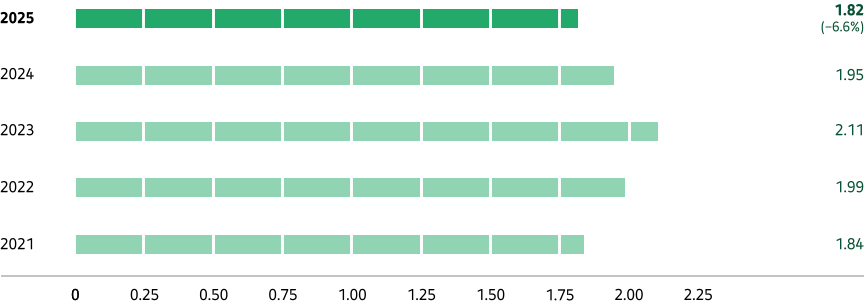
At €229.2 million, earnings after taxes attributable to the shareholders of Bechtle AG were 6.6 per cent below the previous year’s figure of €245.5 million. Basic earnings per share amounted to €1.82, compared to €1.95 in the previous year.
Despite the development described above, the Executive Board and Supervisory Board propose that a dividend of €0.70 per share be distributed again for the 2025 fiscal year. The dividend would therefore remain constant compared to the previous year. In view of the decline in earnings, the company sees this as a strong signal of our reliability for our shareholders. It is also intended to express our confidence in the future development of Bechtle AG. The payout ratio would therefore be 38.5 per cent.

The Executive Board and Supervisory Board are proposing the distribution of a dividend of €0.70 per share – a payout ratio of 38.5 per cent.
Segment report
Germany
Revenue in Germany totalled €3,737.8 million in the reporting period, compared to €3,789.7 million in the previous year, which corresponds to a decrease of 1.4 per cent. In terms of business volume, however, growth of 6.4 per cent was achieved. The fourth quarter in particular contributed to this overall positive development with especially strong demand from public-sector clients, even while our SME customers continued to show a certain reluctance to buy.

Revenue per employee (excluding absentees and trainees) fell in the reporting period on the basis of 9,089 average full-time equivalents (FTEs; previous year: 9,146 thousand) to €411 thousand, compared to €414 thousand in the previous year.
EBIT in the Germany segment rose by 2.1 per cent in 2025, from €226.0 million to €230.7 million. The EBIT margin increased from 6.0 per cent in the previous year to 6.2 per cent. In particular, a higher proportion of services and software and thus a disproportionately low increase in the cost of materials had a positive effect.


France
France achieved revenue of €637.6 million in 2025, compared to €673.9 million in the previous year, which corresponds to a decrease of 5.4 per cent. The volume of business fell by just 2.3 per cent. This market continues to reflect the challenging economic situation coupled with domestic political uncertainty. In addition, we have a higher proportion of medium-sized industrial customers in France, which means that business with public-sector clients cannot have quite the same stabilising effect as in other regions.

Revenue per employee (excluding absentees and trainees) fell to €567 thousand in 2025 on the basis of 1,125 average FTEs (previous year: 1,129), compared to €597 thousand in the previous year.
EBIT in France totalled €16.3 million in the reporting period and was therefore 46.7 per cent below the previous year’s figure (previous year: €30.6 million). The EBIT margin fell significantly from 4.5 per cent to 2.6 per cent. Due to the slight downward development in business volume, it was not possible to offset the costs overall without affecting earnings, despite a reduction in personnel expenses.


Benelux
Benelux achieved revenue of €759.5 million in 2025, compared to €752.5 million in the previous year, which corresponds to an increase of 0.9 per cent. In terms of business volume, the development was significantly more positive at 9.5 per cent. Here too, very favourable demand from public-sector clients played a key role.

Based on 1,145 average FTEs (previous year: 1,080), revenue per employee (excluding absentees and trainees) totalled €663 thousand in 2025, compared to €697 thousand in the previous year.
EBIT in Benelux totalled €33.7 million in the reporting period and was therefore 10.5 per cent below the previous year’s figure (previous year: €37.6 million). The EBIT margin fell from 5.0 per cent to 4.4 per cent. This was due to a disproportionately high increase in personnel expenses.


Other Europe
The countries summarised in the Other Europe reporting segment generated combined revenue of €1,271.0 million in 2025, compared to €1,089.7 million in the previous year. This corresponds to a significant increase of 16.6 per cent. In terms of business volume, the development was even more positive at 18.8 per cent, with our acquisitions in Spain and Italy playing an important role here.

Based on 2,822 average FTEs (previous year: 2,408), revenue per employee (excluding absentees and trainees) totalled €450 thousand in 2025, compared to €453 thousand in the previous year.
EBIT in the Other Europe segment totalled €54.6 million in the reporting period and was therefore 4.3 per cent below the previous year’s figure (previous year: €57.1 million). The EBIT margin contracted from 5.2 per cent to 4.3 per cent. This was due to a disproportionately high increase in personnel expenses.

