

Policies for governance and corporate culture
Our corporate culture plays an important role in the performance and motivation of each individual. It is based on four fundamental values that have remained unchanged for years and are described in the company philosophy, namely: integrity, determination, reliability and inspiration. These fundamental values are a central component of our corporate culture and are attached to every new employment contract in the form of the company philosophy. In conjunction with our internal management principles, our Code of Conduct, our brand foundation, Vision 2030 and the Bechtle Sustainability Strategy 2030, they underpin the long-term strategic objectives. The Bechtle brand foundation, above all, complements the aforementioned fundamental values with regard to corporate culture.
Bechtle brand foundation
The brand foundation was introduced in 2015 and is the basis for Bechtle’s identity. At its core is “Ready for the future”, and there are three attributes that complement and complete this, namely “experienced”, “connected” and “entrepreneurial”. We see the brand foundation as a compass that guides us in the right direction. In this way, the brand attributes simultaneously represent the attitude and behaviour of the workforce.

In the framework of the onboarding event “Mikado” for all new workers, the brand foundation and its significance for Bechtle are explained.
Bechtle Code of Conduct
The Bechtle Code of Conduct is binding for all employees at Bechtle. It forms the basis for the ethical and responsible behaviour of all employees and serves as a binding guideline for everyone to act with integrity. It explicitly includes the commitment to ensuring fair working conditions as an integral component. The content of the Code of Conduct was drawn up by the Legal & Compliance department and approved by the all members of the Executive Board. It is handed out to all new employees with their employment contract and is also available to employees of all companies at all times on the intranet. External parties or third parties can also view it on the Bechtle website (bechtle.com/sustainability). Further information can be found in the Own workforce section.
The Bechtle Code of Conduct focuses on the following aspects:
Conduct towards business partners (corruption, conflicts of interest, financial integrity and money laundering),
Conduct towards competitors (restrictions of competition, unfair competition),
Conduct toward the company (company property, data protection, confidentiality, communication with the media and on the Internet, insider trading),
Conduct towards workers (human rights, labour and social standards, interaction with each other, prohibition of discrimination, handling of internal knowledge),
Conduct towards the environment and society (climate and environmental protection, social responsibility).
The ESRS requires explicit consideration of human trafficking in the Code of Conduct with regard to the company’s own workforce. This requirement is implicitly fulfilled, as we comply with the OECD Guidelines and the ILO core labour standards and take respect for human rights as a fundamental standard.
As a signatory to the United Nations (UN) Global Compact, we have been officially committed to its principles since 2018 and have enshrined this in our Code of Conduct. We also refer to the OECD Guidelines for Multinational Enterprises and the core labour standards of the International Labour Organization (ILO) and align our actions accordingly. The rejection of child and forced labour is explicitly stated in the Code of Conduct, and the prohibition of human trafficking is implicitly taken into account by reference to the aforementioned international standards. In addition, any form of discrimination is strictly rejected. The Code of Conduct specifies sanctions (remedial actions) in the event of violations of the Code or applicable law. All workers can contact the Compliance Board at any time with questions, comments and to report violations of Code (see below).
Internally, the Bechtle Academy offers training courses as part of our management initiative, which are intended to support the corporate culture. This includes content such as communication in crisis situations, expressing constructive criticism, appreciative feedback and leadership. Training courses on topics such as mindfulness, diversity and working in teams are available for all employees.
Our values and our brand foundation form the basis for a responsible and value-orientated management culture. To ensure that this culture can be lived reliably in our day-to-day activities, we supplement it with clear rules and structures that promote and support behaviour with integrity. A key element of this governance structure is an effective whistleblowing system that enables workers and external stakeholders to report potential violations confidentially and securely.
Channels for reporting concerns and violations
Through the German Whistleblower Protection Act (HinSchG), which has been in effect since mid-2023, it should be easy for anyone to point out violations of the law and regulations in their working environment without having to fear retaliation. At Bechtle, the possibility of reporting violations to the Compliance Board – consisting of the Executive Board and the Chief Compliance Officer – was already in place, and we adapted the reporting system and the procedures for processing to the requirements of HinSchG. The establishment, maintenance and tasks of an internal reporting office are assigned to the Legal & Compliance central division. Since the legal requirements, in particular the obligation to introduce a reporting system by the end of the calendar year 2023, have been imposed on almost all (German) Bechtle companies, the Legal & Compliance central division has also obtained written authorisation from each individual company to ensure that the internal reporting office can also be formally operated centrally within the Bechtle Group by the Compliance Board.
All workers, external and third parties can raise concerns or report violations of the Bechtle Code of Conduct, the Bechtle Code of Conduct for Suppliers of Goods and Services or applicable law using the compliance hotline channel. Reports can be submitted confidentially – and anonymously if preferred – by phone, by post or through a dedicated email account. Reports can also be made in person. Reports are received and processed exclusively by the workers in the Legal & Compliance central division, who are trained and bound to strict confidentiality. The compliance team reviews incoming reports and contacts the whistleblower. Subsequently, further actions will be taken in consultation with the whistleblower. These actions are determined on a case-by-case basis and depend on the circumstances of the specific case.
HinSchG requires companies to keep the identity of the whistleblower confidential. Exceptions to this rule are only possible to a very limited extent, for example, when cooperating with law enforcement authorities. In addition, whistleblowers must be protected from any form of retaliation. Bechtle endeavours to ensure that no person is dismissed, transferred to an inferior position, suspended, threatened, discriminated against or disadvantaged in any other way on the basis of a report made in good faith – i.e. in the belief that their own account is true.
To support the availability of the reporting channel, all information on this and a detailed list of questions and answers for employees can be found on the intranet page of the Legal & Compliance department. Furthermore, all necessary information can be found in the Bechtle Code of Conduct, which is made available to workers as part of the onboarding process and is also publicly accessible both on the intranet and on the website. The reporting procedure is also explained as part of the mandatory compliance training to ensure awareness. The company management also attends the training courses.
We consider trust in our reporting channel to be guaranteed in terms of “implicit credibility”, as it is used and workers also contact the compliance team in confidence outside of the complaints channel. In addition, the effectiveness of the reporting channels is ensured by clearly defined processes for processing, documenting and following up incoming reports. Each report is recorded in a structured manner, checked and followed up according to its type and severity. Processing takes place within defined deadlines, and the whistleblower receives feedback on the status and conclusion of the procedure, insofar as this is legally permissible. The Legal & Compliance central division also regularly reviews the functionality of the reporting channels and compliance with the procedural requirements.
Compliance system
The Bechtle Code of Conduct forms the basis of the compliance system. As the central compliance document, it summarises the fundamental, binding compliance requirements. The Code of Conduct summarises the most important compliance risks identified as well as the topics of compliance policy and culture and forms the basis for further, specific internal guidelines.
Bechtle’s Executive Board has approved the compliance system and assigned its monitoring to the Chief Compliance Officer. The Chief Compliance Officer’s function is independent and not bound by instructions. The Officer is authorised to act independently of reporting channels and can report to the Supervisory Board on an ad hoc basis, even without the involvement of the Executive Board. The Chief Compliance Officer is required to inform the Executive Board about the relevant compliance issues as part of the regular reporting for the Executive Board meetings and as required. The Chief Compliance Officer also prepares an annual overall compliance report for the Audit Committee of the Supervisory Board. In addition to cases of (potential) non-compliance, reporting includes relevant legal developments, information on the compliance management system and its individual elements as well as the evaluation of the compliance function.
The employees of the Legal & Compliance central division support the Chief Compliance Officer in the exercise of operational compliance tasks. This includes, in particular, the management of the reporting channels, the processing of reported compliance violations, the development of compliance guidelines and advising the entire Bechtle Group on compliance issues. Access to the central division as an advisory unit is open to all employees, regardless of function and level. The entire Executive Board is part of the Bechtle Compliance Board and is therefore closely involved in the organisation of the Bechtle compliance system on an ongoing basis. This means that the employees responsible for dealing with compliance violations are also part of the management chain.
Our goal is to have a compliance system that is as effective as possible. All managing directors of the group companies and all heads of the central departments are to act as compliance officers. They are obliged to report any violations of the Bechtle Code of Conduct or applicable law to the Chief Compliance Officer in the form of an annual compliance report. The compliance survey for the 2025 reporting period covered all operational and legally independent companies of the Bechtle Group as well as all central divisions, totalling 130 units.
The following illustration shows the compliance organisation in the overview:
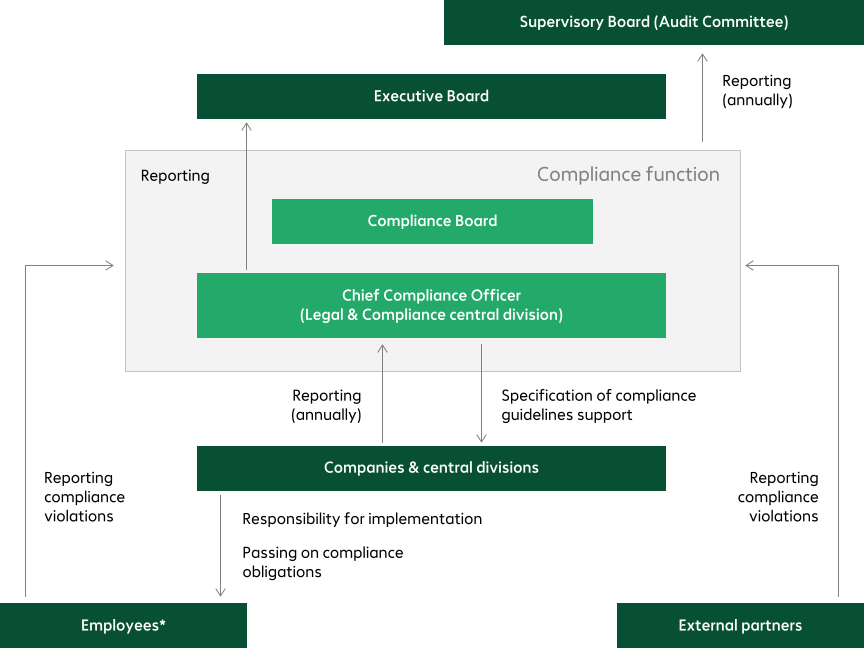
The compliance management system applies to the entire Bechtle Group in Germany and abroad and is based on a regular group-wide risk assessment by the Legal & Compliance central division and the involvement of all relevant specialist departments and companies. The compliance obligations are assessed with regard to activities, service portfolio and other relevant aspects of business activity and set in relation to the probability of occurrence, potential damage and risk-minimising actions. The structure and evaluation method correspond to the procedure of central risk management (see further information in the opportunity and risk report).
The Compliance System is described in the Bechtle Compliance Management Manual. This was revised in 2024 and is available to all workers on the intranet under Legal & Compliance. Training is a central component of our compliance system and serves to sensitise all employees to compliance risks and thus promote a sustainable compliance culture. All employees, which corresponds to 100 per cent, including high-risk functions, executives and the Executive Board, as well as governance bodies, are required to attend the annual online training course on general compliance and anti-corruption requirements, which has been offered since 2022. The approximately 40-minute basic training course covers all relevant compliance areas listed in the Bechtle Code of Conduct and can only be completed after passing the test. The e-learning policy is designed for the long term and is therefore rolled out to workers every year with changing content and new modules. The last update took place in autumn 2025 and was published in mid-December. The basic training still contains general compliance and anti-corruption requirements, but the case studies focus particularly on conflicts of interest. In addition, special corruption prevention training has been designed and rolled out since 2024 for selected or particularly vulnerable areas in the Bechtle Group. This course is assigned to the following employees: all field sales and internal sales employees of the Bechtle companies based in Germany, Austria and Switzerland, the Public Sector Division and all employees of the purchasing department of Bechtle Logistik & Service GmbH. In this case, there is no training for the Supervisory Board in this regard; compliance with the legal requirements is the responsibility of the individual.
Prevention and detection of corruption and bribery
The processes and actions integrated into our compliance system form the basis for promoting ethically correct and lawful behaviour and for combating and minimising any risks of corruption and bribery. Combating corruption is an explicit part of Bechtle’s compliance strategy. The compliance system serves to prevent illegal or criminal offences within and outside the company.
In the previous reporting periods, we had already begun to fundamentally revise the former Bechtle Incentives Guideline and the decision-making aids for granting and receiving benefits. To address the risk of corruption as a result of non-transparent business practices and the resulting compliance, sanction and reputational risks, Bechtle published a group-wide anti-corruption guideline in 2025. This combines the guiding principles of the previously applicable regulations, in particular the incentives directive and the decision-making aids for accepting and granting benefits, and brings them together in a standardised document. The existing requirements were further supplemented, concretised and systematised.
The anti-corruption guideline creates transparency with regard to permissible and impermissible business practices towards business partners and the behaviour of employees, thereby reducing the scope for interpretation. The modular design of the test schemes facilitates standardised application and increases reliability in decision-making processes. The guideline thus serves to prevent cases of corruption that could otherwise lead to sanctions and/or financial penalties for Bechtle under criminal law, and at the same time counteracts reputational damage.
Responsibility for implementing and monitoring the anti-corruption guidelines lies at the highest level with the Head of the Compliance department. They report directly to the Chairman of the Executive Board of Bechtle AG and thus ensure that the guideline is appropriately anchored in the group’s governance structure.