

Transition plan for climate mitigation
How we as an entity can contribute to climate mitigation and adaptation to climate change is defined in our Climate Mitigation Strategy 2030. It has been approved by the Executive Board and contains our SBTi-aligned short and long-term reduction targets. The climate protection strategy complements the Bechtle Sustainability Strategy 2030. This transition plan describes the strategic orientation of our entity with regard to achieving the climate targets for limiting global warming to 1.5°C. It also presents the reduction targets, the decarbonisation levers, the actions and the planned investments.
The climate targets are compatible with the Paris Agreement. Bechtle is not exempt from the agreed EU reference values. The achievement of the defined CO2 emission reduction targets is as CO2 intensity in relation to the value added part of the remuneration system for the Executive Board. The definition of value added follows the definition of SBTi and represents gross profit. The transition plan flows into all of Bechtle’s business processes. Positioning ourselves as a provider of climate-friendly digital solutions by integrating sustainable IT offerings into the product and service portfolio – in close co-operation with manufacturers and partners and measured against clearly defined measurement criteria such as energy efficiency, service life and CO2 values – is an expression of this strategic focus. Sustainable policies such as the vehicle fleet strategy or the sustainable property concept also take climate targets into account in the area of investments. In financial planning, future integration takes place in the case of material amounts such as the budget or investments for photovoltaic systems or expenditures for future neutralisation projects.
Decarbonisation levers and actions
In the area of our business activities, our vehicle fleet contributes significantly to emissions and accounts for almost 74 per cent of Scope 1 and 2 emissions based on 2023 emission values. The vehicle fleet therefore represents the largest area of emissions in Scope 1 and 2. In addition, there are energy costs for the maintenance of office buildings, warehouses and data centres. In the upstream and downstream value chain, emissions are generated during the production, transport and use of the products we sell. We therefore focus our climate mitigation metrics on the largest emitters of CO2e emissions in the areas of mobility and energy for Scope 1 and 2 emissions as well as logistics and procurement, including centralised and decentralised purchasing and responsibility in sales for the Scope 3.1 and 3.11 emission categories. The most important levers for decarbonisation here focus on technological processes.
These are the focus topics of Bechtle’s climate mitigation strategy:
Energy:
Increasing the energy efficiency of our locations
Purchase of green energy
Mobility:
Electrification of vehicle fleet
Expansion of charging infrastructure
Procurement:
Decarbonisation of the supply chain
Energy efficiency and savings in the use phase
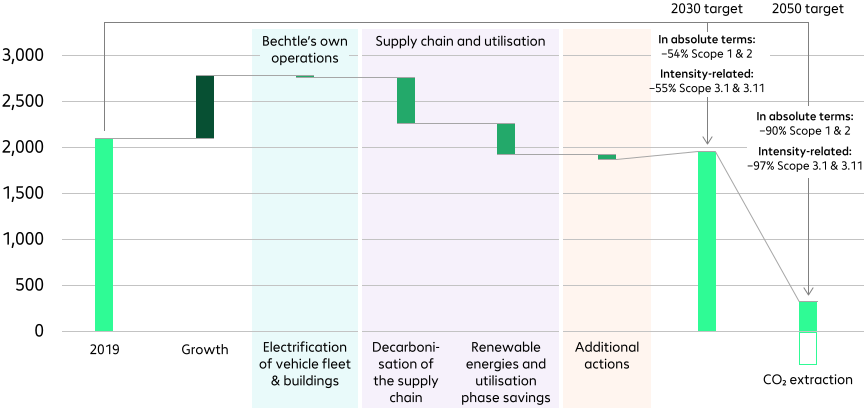
The actions we have implemented are listed below. From 2026, a regular status report on the decarbonisation measures with milestones will be published as part of the sustainability reporting. Responsibilities are defined internally.
Emissions category |
|
Decarbonisation levers |
|
Concept |
|
Group-wide actions |
|
Status |
|
Interim result |
|
OpEx/CapEx |
|||
|---|---|---|---|---|---|---|---|---|---|---|---|---|---|---|---|
Scope 1 vehicle fleet |
|
Electrification of vehicle fleet |
|
Sustainable fleet strategy |
|
Increasing the share of alternative drives |
|
Ongoing |
|
As of 31 December 2025, 34 per cent of the almost |
|
Reference to EU taxonomy |
|||
|
|
|
Expansion of the charging infrastructure |
|
Ongoing |
|
Around |
|
Not significant |
||||||
Scope 2 energy |
|
Increasing energy efficiency and supplying green energy |
|
Sustainable property policy |
|
Data centres with green electricity |
|
Implemented |
|
|
|
Not significant |
|||
|
|
|
Increasing energy efficiency at the locations |
|
Ongoing |
|
|
|
Reference to EU taxonomy |
||||||
|
|
|
Self-supply of electricity through expansion of PV and geothermal energy |
|
Ongoing |
|
55 per cent electricity from renewable sources (as of 2024) |
|
Not significant |
||||||
|
|
Framework agreement D |
|
Purchase of green electricity in Germany |
|
Almost finalised |
|
|
Not significant |
||||||
|
|
|
|
Purchase of green electricity group-wide |
|
In preparation |
|
|
|
|
|||||
Scope 3.1 |
|
Decarbonisation of the value chain |
|
|
|
Manufacturers' emission reduction targets for lower-emission products* |
|
Ongoing |
|
|
|
|
|||
|
|
Sustainable procurement strategy |
|
Close co-operation with manufacturers for CO2 data transparency as the basis for lower-emission portfolio selection |
|
In preparation |
|
|
|
|
|||||
|
|
Sustainable sales concept Sustainability@Scale |
|
Sustainable IT portfolio (lower product emissions) |
|
In preparation |
|
|
|
|
|||||
|
|
Circular economy concept hardware |
|
Circular IT – Increase refurbishment |
|
Ongoing |
|
|
|
|
|||||
Scope 3.11 |
|
Energy efficiency and savings in the utilisation phase |
|
Sustainable sales concept Sustainability@Scale |
|
Sustainable IT portfolio (energy efficiency, service life extension) |
|
In preparation |
|
|
|
|
|||
|
|
|
|
Product leasing from Bechtle |
|
Ongoing |
|
|
|
|
|||||
|
|
|
|
IT-as-a-Service |
|
|
|
|
|
|
|||||
|
|
Sustainable procurement strategy |
|
Manufacturers’ energy efficiency targets* |
|
Ongoing |
|
|
|
|
|||||
|
|
|
|
Decarbonisation of the electricity mix in the use phase* |
|
Ongoing |
|
|
|
|
|||||
|
|||||||||||||||
Customer proximity is part of our business model. The Bechtle account managers, consultants and IT service engineers therefore need to be mobile in order to take care of the customers on-site, and as a result the vehicle fleet in the Bechtle Group accounts for a significant proportion of the CO2e emissions caused by Bechtle. This is why the expansion of e-mobility is the biggest decarbonisation lever in Scope 1 in the area of our own business activities. By continuing and further developing the existing sustainable vehicle fleet strategy, Bechtle is gradually realising the switch to sustainable drives. As of 31 December 2025, 34 per cent (2024: 23 per cent) of the just under 5,800 (2024: 5,600) vehicles are fully electric.
The energy consumption of the buildings used by Bechtle is an important starting point for reducing or even preventing emissions. Sustainable property policies for the Bechtle Group, climate-friendly energy supply through the purchase of green electricity (as of 2024, 55 per cent of electricity consumption came from renewable sources) and in-house generation using photovoltaics and geothermal energy as well as energy efficiency actions are the key measures for reducing Scope 2 emissions.
In the area of Scope 3 emissions, the focus is on sub-category scope 3.1 “Purchased goods and services” and 3.11 “Use of products sold” as the main sources of our emissions. Cooperation with suppliers for CO2 data transparency and sustainable product information, a sustainable procurement strategy – including to reduce negative environmental and social impacts – and a sustainable sales concept “Sustainability@Scale” – including the development and expansion of a sustainable product portfolio definition – are the most important actions planned to achieve our Scope 3 reduction targets.
We expect an increase in the proportion of renewable energies in the electricity mix of the sales countries, which will lead to emission savings in the use phase.
Based on the assumptions made with regard to the quantification of actions, a gap in the reduction of emissions still needs to be closed in order to realise the climate target set for 2030. In addition to the reduction actions already planned, projected and initiated, this will require further activities that will be determined in the coming fiscal years.
To achieve the net-zero target by 2050, remaining emissions up to a maximum of 10 per cent of total emissions will be neutralised through carbon removal projects in accordance with the SBTi criteria. Project selection is part of the current provider screening for neutralisation projects and will be completed in the first quarter of 2026.
Measurement of transiton risks and opportunities in the transition plan
As part of the climate risk analysis carried out in 2024, Bechtle has identified material transition risks that are taken into account in the transition plan. These relate in particular to the decarbonisation lever of procurement and refer to uncertainties in market development, as well as the limited influence on or dependence on suppliers and their progress with regard to climate mitigation and emission reductions. The resulting increase in procurement costs must be factored in.
The implementation of actions to save energy and electricity as well as the expansion of the renewable energy supply and the resulting possible reduction in energy consumption, on the other hand, represent opportunities in the transition to a sustainable economy.
Investment and financing plan
A material focus on the necessary decarbonisation actions lies in the upstream value chain as it is where the majority of our greenhouse gas emissions are generated. Corresponding actions are primarily implemented by our suppliers as part of the climate targets they set; this does not currently result in any material operating or investment expenditures for our entity. Investments in the charging infrastructure and building efficiency are planned for the further implementation of the transition plan. Quantification is part of budget planning. The decarbonisation levers of our business activities in the areas of the vehicle fleet, charging infrastructure and buildings are reflected in the EU taxonomy activities. The key decarbonisation levers of our business activities – particularly in the areas of vehicle fleet and charging infrastructure as well as building energy efficiency – are reflected in the relevant EU taxonomy activities. They include 6.4/6.5 (vehicle fleet management) and 7.4, 7.6 and 7.7 (construction and building actions).
All activities mentioned are taxonomy-eligible; alignment in accordance with the technical evaluation criteria is currently realised in activity 6.4 and partially in 7.7. In the vehicle fleet area, our investments in the electrification of the vehicle fleet make a material contribution to climate mitigation. In the area of buildings/new construction, the material contribution to climate protection is made by supplying green energy and increasing energy efficiency. In accordance with the provisions of Commission Delegated Regulation (EU) 2021/2139, the economic activities in the area of the vehicle fleet and buildings are reviewed annually in order to align them with the assessment criteria of the EU taxonomy and are developed further if necessary (for more information, see the EU taxonomy chapter).
No significant CapEx payments are made in connection with economic activities in the coal, oil and gas sectors.
Assessment of the potential locked-in greenhouse gas emissions
As part of the implementation of our transition plan, we have carried out a qualitative measurement of the potential greenhouse gas emissions associated with our material assets and products. Bechtle AG is primarily an IT system house and IT e-commerce provider, i.e. not a traditional producer of physical, energy-intensive goods such as steel or cement. Nevertheless, it deals with products that directly cause very relevant emissions. This shows that the manufacture of purchased IT hardware, the use of IT hardware sold, the operation of data centres, the use of large office buildings owned by the entity and mobility solutions in the form of the vehicle fleet are particularly relevant sources of emissions.
These locked-in emissions may affect the achievement of our SBTi-based reduction pathways by 2030 and our net-zero target by 2050, particularly if technological changes to lower-emission and more energy-efficient IT hardware are delayed. This results in transition risks such as rising procurement prices, changing customer preferences, increased demand for sustainable IT, supply chain adjustments and reputational risks.
We are pursuing a multi-stage approach to minimise risk:
Bechtle does not identify any material long-term emissions in the areas of vehicle fleet and office buildings. The vehicle fleet is being electrified, buildings are being energy-optimised and there is a switch to renewable energies in the area of power supply. Supplying the data centres with green electricity ensures that no material locked-in emissions are to be expected here either. Long-term co operation with partners who guarantee sustainable operation of the data centres is the set target. A sustainable procurement strategy, the establishment of prerequisites for decarbonising the supply chain through close cooperation with our vendors, including a focus on emissions, the expansion of product master data to include sustainable criteria such as CO2 for data transparency as the basis for recommendations for action, IT refurbishment and new business models such as IT-as-a-Service, will help to counteract possible locked-in emissions in the procurement and life cycles of IT equipment in the future.